
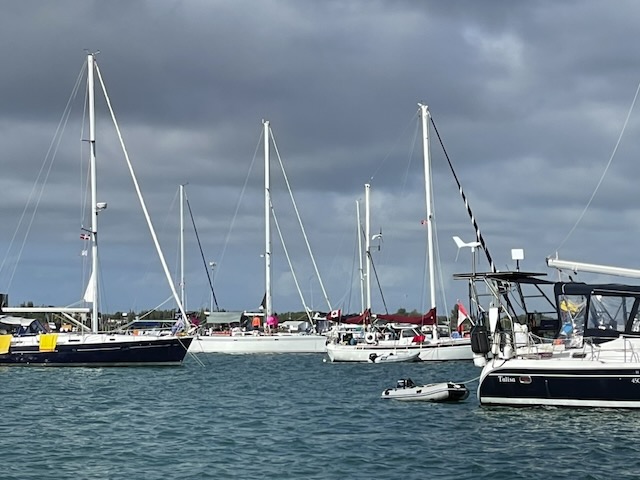
With the advent of modern anchors like the Mantus and Rocna, it has become unfashionable to put out two anchors. These new design anchors are incredibly reliable. They often provide quick resets in even the worst conditions. So much so that modern dogma (and advertising) has made many boaters believe that one good new one is always better than two old ones.
But, after a decade of living aboard — a majority spent at anchor — I’m here to tell you the sad news: No anchor is 100% reliable at resetting itself. Good seamanship dictates that we take action to ensure our anchors will remain set should the worst or the unexpected happen. It is, after all, the ocean. In the words of one famous captain, “If it’s gonna happen, it’s gonna happen out there.”
But that’s not the only reason to set two anchors. Once you get good at it, you’ll quickly realize that it gives you the power to control your swing. And that means you fit in places that were off-limits before.
This guide is mostly aimed at boaters on the US East Coast, ICW, and Bahamas, with specific examples of setups I’ve successfully used.
Why Should You Use Two Anchors?

The introduction probably gave it away, but yes, you should and sometimes must use more than one anchor to consider yourself safe from dragging. Not all the time, and likely not even most of the time. But sometimes, it is the only way you can be certain that your boat will not drag.
As a result, all cruising boats should have at least two anchors aboard that are capable of holding the boat in pretty good blows. Most of the time, the secondary will sit there and collect salt spray. But it’s there if you ever need it. Maybe you lose your primary, your primary starts to drag and you’ve run out of options, or you need to fit in a tight anchor tucked up a creek for a big blow.
This leads me to one of the first points I want to make here, because it’s a big one.
Anchoring Rule No. 1: Always anchor like it’s going to blow 60 knots or more with little or no warning. Because sometimes it does. Really.
Below is a short video of an afternoon storm that blew in while anchored in Hampton, Virginia. Of course, it came from an unexpected direction and put us on a lee shore, a rocky seawall that looked very intimidating indeed. Thankfully, the primary held, but only because I followed Anchoring Rule No. 1 (see above).
The gust front of this afternoon’s summer thunderstorm hit us with 65-knot winds for about 10 minutes. A similar event has happened to us once or twice a year since we started cruising.
Why Two Anchors Is Sometimes Better Than One
Assuming you have a primary anchor that is of suitable size for your boat, that its design is suitable for the seabed composition, and that it is set correctly on an appropriate type and length of rode, one anchor will suit about 90% of the anchoring conditions you will encounter. (Yes, that’s a lot you have to get right to get up to 90%.)
Even if you hesitate to put out two anchors, if you realize when you’re in the other 10%, you may be able to cope by picking another spot to anchor. This may mean you’re in deeper water, or more exposed to the conditions (chop or swell), or maybe you just take a marina slip for the night. But at least you didn’t have to put out the other anchor, right? Speaking from experience here.
But once you get over it and start setting two anchors, you’ll probably find all sorts of times when it’s useful. It opens up more anchoring options for you immediately. It means you can anchor up a creek for a big storm instead of coping out in the slop. It means you can get right next to town for a shorter dinghy ride. It means you can avoid the newbie dragging drama in the big anchorage and favor quieter, tighter spots they avoid.
When Is There an Advantage to Using Two Anchors to Moor a Vessel?
There are two reasons why deploying a second anchor is beneficial.
First, having a second anchor deployed can control your swing radius. When you are lying on one bow anchor, the boat can swing anywhere inside a circle centered on the anchor’s location. That’s 360 degrees of possibilities. With a 100-foot rode and a 180-degree wind shift, that means your boat is going to move 200 feet from one side of the circle to the other.

The other advantage of two anchors is that it can ensure each anchor will remain set. The set of the anchor is how well it is dug into the seabed. An anchor has no holding power until it is firmly set.
It’s up to the skipper to set an anchor properly; it shouldn’t be expected to happen by magic or design. If the anchor does come unstuck, be it due to poor holding ground or a sudden 180-degree wind change, only the anchor’s design will get it stuck again. This is where modern anchors shine: Most are designed to dig in and reset themselves (hopefully). Older models cannot be trusted to do so.
So if you can’t trust an anchor to reset itself 100% of the time, you can use two anchors to ensure that it’s never an issue. You have one anchor deployed in each direct the weather will come from. That way, for each wind or current shift the boat has a dedicated anchor to hold it. No anchor will come unstuck, and each will remain firmly set in its original direction.
This also indirectly controls your swing radius. If you have two anchors set, and the boat lies somewhere between the two, the size of its swing radius is cut in half (or less).
Techniques for Deploying Two Anchors
There are different ways to use two anchors, and each has advantages and disadvantages. Conditions will dictate how you set your anchor, and you must decide whether using two would help.
One Anchor

You’ll spend more than 90% of your time at anchor using only one, so it’s a good place to start. And that’s why I make sure my primary bower is a great anchor: a modern design that’s slightly oversized for my boat (but not too big for me and my windlass).
No matter how many anchors you have out, the set of the anchor is the key detail: You must know the anchor is dug into a solid seabed and that it’s not going to let go unexpectedly. You don’t want it hooked into grass (that could pull out by the roots) or jammed on a rock (which might pop free with any little wind shift).
Even when an anchor is set well, it will only stay that way if it is connected to enough rode (5:1 scope minimum) and the load on that rode remains in line with the anchor. If the boat starts pulling on the rode at a 90-degree or 180-degree direction, it’s completely possible — not even that surprising — for the anchor to pull free. This is the dirty secret modern anchor makers don’t want you to think about. Some say this never happens; some say the anchor will reset on its own. And yet these scenarios happen every day. Yes, new anchors do USUALLY reset. Usually. How comfortable are you with “usually” in the dark at 2:00 a.m., in a thunderstorm gusting 40 or 50 knots, and a rocky seawall behind you? “Usually” works fine for your first year of cruising, but the longer you’re out and the more you travel, the more stuff you see. Eventually, you’ll realize that “usually” is a risky gamble.

Many cruisers will have you believe that the only way to know an anchor is set is to dive in and look yourself. This is fine on calm days in the warm, clear waters of Florida or the Bahamas. But even then, very few people are doing it.
The truth is muckier. You’re in the Carolinas, the water is cold (maybe it’s November, and there’s frost on the boat), water visibility is no more than 3 inches, and even if you could see the anchor down there, it’s buried in black, soupy muck. But you still need to know it’s set — that soup could be loose silt that will never hold.
So diving the anchor is not the answer. The answer is using an anchoring technique that purposefully and carefully sets it, and then tests that set for its performance. Keep reading for my how-to.
Pros of One Anchor
- Simplest setup and retrieval
- Keeps the bow into the wind/waves
- Matches what most other boats are doing
- Easy to add more scope or reduce scope if necessary
- Easy to adjust with snubbers or swell bridles
Cons of One Anchor
- Requires the anchor to reset itself after a wind shift
- When wind is opposite current, boat will sail over the anchor and can pull it out
- If anchor loses its grip (becomes un-set during a wind shift or anything else happens), there is no backup
- More scope means wider swing radius
- Cannot be used in tight anchorages where others are using two anchors, you’ll sing into people and anchor lines will get tangled
How to Set One Anchor Correctly
- Approach your desired anchoring location, putting the boat approximately where you want it to sit and pointed into the wind or current (whichever is most prominent; look at other similar boats to clue you in on how yours will lie)
- Proceed forward into the weather slowly for approximately the distance of rode you need. Always a minimum of 60 feet (2-ish boat lengths) or so, assuming a scope of 5:1 in 8 feet of water, but much if the water is deep or you’re using nylon rode.
- Drift to a stop here and let go the anchor while stationary. As the boat begins to drift back on the wind, deploy the desired length of rode.
- When you’ve eased out the desired length of rode, secure it temporarily. Let the boat settle and pull the line tight, just by drifting on the wind or current. Don’t rush this phase, because it allows the anchor to settle through any loose muck and dig into the bottom. Ensure the anchor is beginning to set — that the line does not bounce and the anchor does not drag.
- Now secure the anchor well, using your snubber or bridle to secure it. Deploy extra rode so that it will always ride on the snubber/bridle, never on the rode.
- Now put the engine in reverse (idle only to start) and pull back on anchor. Keep an eye on the rode to ensure no bouncing, which indicates that the anchor is not set. Take range sights using a nearby object and a distant object off the beam to ensure the boat is not moving astern.
- Gradually increase power astern, stopping at any sign of failure of the anchor set. Bring the engine up to about 2/3 cruise power (~2,000 RPM on most sailboats) to really pull on the anchor. You should see a good amount of wash around the boat, and the anchor line should be guitar-string tight. Watch for bounce and take more range sights to ensure you aren’t moving at all. Keep this power set going for one or two minutes, then gradually reduce power to idle and shut down.
Bahamian Mooring — Two Anchors Off the Bow
The basic idea of a Bahamian mooring is that you’ll have an anchor set in the direction of whatever weather is expected. Since the anchors are both set off the bow, the bow remains pointed into the wind as it should. The anchor line that is not in use goes slack, until the weather shifts again and it’s needed again.
One thing to note with this method is that nearly every diagram I see is inaccurate. They often depict two anchors set off the bow at about 45 degrees from one another. While you could conceivably do this, it ignores the point of the exercise: You more likely want them set as much as 180 degrees apart.

And, by the way, it’s not limited to just two — you could set three or more anchors.
Let’s look at three real-world scenarios where this might play out.


Scenario 1: A narrow tidal creek, like those found in the Exumas (hence the name)
In this case, you want to anchor the boat in a narrow spot, with limited swing room to keep the keel in deep water. But a swift current is going to reverse every six hours, so you know that setting only one anchor will only work temporarily. One anchor is set so the boat rides it on the incoming tide, and the other anchor is set 180 degrees opposite, so the boat sits on that one during the outgoing tide.

Scenario 2: A cold front is coming, and you’re expecting a 180-degree wind shift
Now you’re anchored in an open anchorage and swing room isn’t the problem. The issue is that when you arrive, the winds are southeasterly at 10-15 knots, forecast to shift to northwesterlies at 20-25, gusting 35, starting around 2:00 a.m. It’s always around 2:00 a.m. In addition to the wind shift, you may also expect gusty squalls, which means it’s not unreasonable to assume much higher winds (50-60 knots possible in the gust front).
Setting a Bahamian mooring in this situation means you can set both anchors the evening before and go to sleep knowing the boat won’t drag and will be safe and secure throughout the blow. Since you set the anchors in advance for the expected conditions, you know they are already set — you aren’t waiting for them to magically reset on their own.
Of course, you aren’t likely to sleep through it — you’ll be up just to make sure the second anchor holds and that no one in front of you drags into you. But your worries shift from being the one that’s dragging to worrying about all the other folks who are dragging, and that’s a fundamental shift that changes your cruising lifestyle.
Scenario 3: Tropical storm passage
Okay, please don’t do this. But I have a friend who rode out a Cat 3 hurricane by putting out three enormous anchors in this fashion, each positioned for the worst of the forecast conditions. It’s the same principle as the cold front passage above, taken to another level with another anchor added.
Pros of the Bahamian Moor
- Provides reliable holding with a set anchor from different wind/current directions
- Keeps both anchors set securely
- Keeps the bow into the wind
- Minimizes swing radius (boat stays between the two anchors), so it’s good in tight spaces
Cons of Bahamian Moor
- Tricky setup requires planning and careful implementation
- Anchor rodes can get wound/twisted together over many tide/wind shifts unless you rig a swivel
- You don’t want to be the one on two anchors when everyone else around you is only using one; they’ll swing right into you!
How to Set a Two-Anchor Bahamian Mooring Correctly
- Follow the instructions for setting your first anchor into the existing conditions as described above.
- Once that is complete and the first anchor is securely down, you can deploy the second one of two ways.
- You could drop the second anchor in the dinghy, and dinghy it out to where you need it to be, much like you would for a kedge. Drop it there, then set the anchor using power or a winch/windlass from the boat. Be sure to leave enough extra scope when setting it to take up the slack and let the anchor dig, leaving the appropriate scope for the expected conditions.
- You could do it all from the boat, under power. This is easier in the creek scenario, where the tidal currents are 180 degrees opposite of one another. After the first anchor is set, continue letting out rode until you’ve doubled it (and then a little more). So, if your first anchor was supposed to sit on 100 feet of rode, let it out until you’re about 210-220 feet from the anchor.
- At this point, let go your second anchor. You’ll now deploy the second rode while taking up on the first, bringing the boat back to the center of the two rodes.
- Once the first rode is back to its intended length, make it fast. Bring the second rode tight (it will be running under the boat, so use caution not to foul your running gear!). Depending on your setup, you can set anchor by bringing up on the rode with your windlass or powering forward (again, with caution!)
- Because it’s impossible to get as good a set with the second anchor as you do with the first (you won’t want to bring a lot of power with a rode under the boat like that), you’ll want to monitor that it’s set well on the first shift of weather. When the boat has turned to face that anchor, you may want to do a power set, just to confirm it’s set well.
In the video below, Paul Shard of Distant Shores does a great job demostrating how to set up a fancier anchoring including swivels so your lines don’t get tangled.
River Trot Mooring — Bow Anchor + Stern Anchor

Trot moorings are common in tidal areas where you want to pack a lot of boats into an area but have no room to let them swing. The boats are then arranged in tight lines, secured bow and stern.
The same can be done with anchors, one off the bow and one off the stern. This keeps the boat nearly stationary through wind and tidal changes, but it means that the weather does not hit the boat on the bow, so it can only be used in the calmest, most protected spots. If there’s any chance of chop or waves, don’t use this type of anchoring. Waves over the stern can swamp a boat, and most boats do not have adequate deck gear to hold them stern-to in anything but the mildest of conditions.
I’ve used a trot anchoring setup on calm nights in narrow creeks in the Carolinas without problem. It’s not a setup for a storm, but it means you can sit snuggly along a marshy shoreline for a calm night away from the anchorage shinnanigans.
Pros of the River Mooring
- No swing; keeps boat nearly stationary for anchoring in narrow rivers or channels (it can still move side to side a bit)
- Straightforward setup
Cons of the River Mooring
- Bow not held into wind, so it’s only usable in protected conditions
- Weather on beam sideloads anchors and deck gear
- Weather on the stern could swamp the boat
- Requires moving a set of ground tackle to the stern
How to Set a Two-Anchor Trott Mooring Correctly
- The setup here is much like the Bahamian mooring. Set your first anchor into the existing conditions as described above. The fall back double the distance (plus a little) and let go your second anchor. Then bring the boat back to the center between the two.
- The trick here is to make the second anchor fast to the stern. If you’re using a bower, you may be able to simply snubber the line off a stern cleat and leave the rode slack between bow and stern, but be careful not to foul the rudder or running gear. The advantage with the system, though, is that if conditions build from astern, the second anchor’s snubber can be let go, allowing it to swing around bow-to the weather.
- You don’t want the two rodes to be taut; they need a little play for tide changes. But you also don’t want too much slack, which will enable the boat to move side-to-side more than you might like in such a tight space.
Storm Mooring — Two Anchors in Line

This is the scenario that many people envision when they think of using two anchors, but it’s seldom used and the sort of thing you read about in books and never consider doing. The only practical reason to try it is if you’re anchored somewhere that you do not expect a wind shift, but you do expect the winds to be so extreme that you do not believe the holding power of your primary anchor will be sufficient. It’s the sort of thing I envision people doing along the Northwest Passage or in Patagonia — that’s the level of seamanship we’re talking about here to pull this off.
Pros of Two In-line Anchors
- Increases the holding power of a single anchor in the worst conditions
Cons of Two In-line Anchors
- Rarely used and rarely necessary; generally not recommended
- Difficult setup and retrieval
How to Increase the Holding Power with a Second Anchor Correctly
- The setup for this is going to depend on the gear you have aboard and how you can work it out. Here’s the basic idea:
- Deploy the biggest anchor you have as if you were only setting on. Let go a fair amount of rode.
- Pause, and secure the second anchor to the same rode with an anchor shackle. Let go the second anchor and more rode.
- Play out the amount of rode you need for the storm, likely 10:1 scope, and power set as you would with one anchor. The idea is that the two anchors should set together as the rode comes under load. But there’s no real way to confirm if you’re laying on only one of the two anchors; at least if one begins to drag, the second may dig in to save you.
Two Anchors — Worth the Effort Sometimes
If there’s one thing that long-time cruisers value above most other things, it’s a good night’s sleep. But there’s also the knowledge that when you leave the boat and go to shore for a few hours, it will be right where you left it.
Leave a Reply