
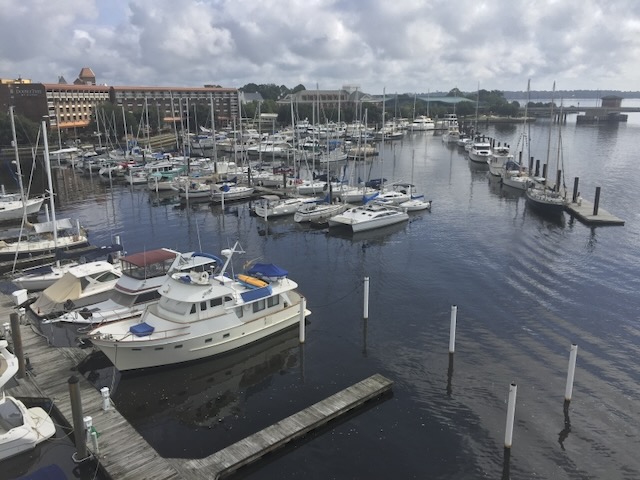
Living on a boat is a dream shared by many people, but being a liveaboard means different things depending on how you intend to do it. Will you be parked at a marina, essentially using your boat as a waterfront condo? Or will you be traveling by boat, actively cruising, and living on board while you do it? When considering marinas and searching for the best places to live on a boat, these details matter.
Here’s a look at why you might want to try living aboard, some of the problems you might encounter, and my top list of best places to do it on the eastern shore of the US.
Why Liveaboard a Boat?
There are as many reasons to live on a boat as there are people doing it. But, in our travels, we’ve found three primary reasons people do it: in order to travel by boat, because they like the lifestyle, or because they need cheap accommodations.
You want to travel by water

Cruising boaters live on their boats full time while traveling, but they aren’t really “liveaboards” (more on that in a moment). Even the most active cruisers stop the boat once in a while to take a break from the rigors of being on the road all the time.
Some stop to make some money or work on boat projects. Some cruisers plan stops, knowing they’ll want to take a break. Moving the boat every day (or every few days) takes a lot of energy, work, and planning. It’s nice to take a month off here and there.
These boats are usually ready to go anytime; their owners are just hanging out in one spot while they take care of business. This is where you’ll find nice cruising boats, sailing catamarans, and a lot of trawlers and small motor yachts.
You like the unique, alternative lifestyle of living aboard on the water

Being on the water is a special experience, and living on a boat is the perfect way to do it. Imagine waking up, having coffee in the cockpit, and watching manatees or dolphins swim by. That’s the best part of life on a boat in a nutshell, so it’s a wonder more folks don’t want to try it.
From a desire to live simply to the social aspect of boating, it’s a distinctive lifestyle that suits many. The thing that sets this group apart from those above is that they’ve got a long-term arrangement to live at the marina (or at the mooring ball and occasionally at anchor).
Often, we see that these boaters don’t move much, but their vessels range in condition from being stuck to the bottom to being ready to cross an ocean. There are houseboats, sailboats, tugs, trawlers, and everything in between in this group.
You need cheap accommodations
It’s a terrible reason to buy a boat, but we know some people live on boats because it can appear more affordable when compared to rents in coastal areas. However, this overlooks the costs of maintaining a boat in a seaworthy state, not to mention regular slip and yard fees. It’s pretty hard to save money and buy a boat at the same time.
Derelict boats are a problem in many areas, where owners have illegally abandoned their boats, leaving the authorities to determine what to do with them. Unfortunately, this comes back to the rest of the boating community in the form of more liveaboard and anchoring restrictions. This describes way too many old sailboats, which can be bought for anywhere between $0 and $5,000.
Finding a Slip — Are You a Cruiser or a Liveaboard?
Liveaboards will choose between spending their time tied up in a marina slip or swinging “on the hook” at anchor. Usually, the dream is to live on the hook, but, after a while, most boaters wind up in marinas for convenience’s sake. Marinas provide fresh water, electricity, laundry, package delivery, parking, restrooms and showers, sewage pump-outs, and sometimes even courtesy cars.

Anchoring is problematic for day-to-day life. It’s great while traveling and visiting new places, but if you’re trying to live in one spot, you need the conveniences of a place to get ashore, and maybe a place to park your car or bike, or at least be in walking distance to the necessities. Finding those things is no simple matter, and in some areas (South Florida) it can be impossible.
No matter where you are, someone is going to frown on you staying anchored in one spot for months at a time. Most boats do not have hot water or air conditioning without running a generator constantly, which becomes a drag after a while. What’s more, life at anchor means continuously worrying about shifting winds, severe weather, not dragging anchor, and other boaters getting too close.
So, even if you’re able to spend a lot of time at anchor, most boaters we know will want to move into a slip for some period. It’s usually more time than they realized when they first started boating.
If you are actively traveling as a cruising boater, finding a slip is pretty straightforward. You want a transient slip, even if you want it for three months to stay all summer. Dockmasters understand that your boat is your home, and they know that you’re living aboard. But you aren’t really a liveaboard, at least as far as they’re concerned!
A liveaboard is a person who lives in their marina, much like a tenant, keeping their car there and receiving their mail there. It can become complicated for dockmasters, as this might make evicting them and their boat more difficult if they stop paying. It also might be against the law, depending on local ordinances.
The moral is that there’s a big difference between taking a transient dock and living aboard, at least from the point of view of a dockmaster or marina owner. Some are cool about it, and some are not.
If you can continue traveling, staying for only a month or two here and there, you’ll have a much easier time finding slips than you would trying to find annual prices for liveaboard slips. Of course, this means that you have to actually travel, and that’s a problem for some boaters!
One compromise to the anchoring versus marina life question is getting a mooring ball. Some marinas and cities operate moorings fields, and that means you get access to the marina facilities (parking, laundry, showers, mail, etc.) but don’t have to have the trailer-park-like experience that living in a marina can be. Mooring balls are significantly cheaper than slips, but you’ll still have to figure out power, water, and pump outs.
4 Best Places to Live on a Boat in the US (East Coast)
What makes the perfect place to liveaboard? In my mind, it comes down to several factors, and those might be a little different for everyone. If you’re reading this, it probably means you get a choice in where you go. If you have a job or are based in a particular city, then your options are limited.
If you get to choose, I would select based on three factors:
- How friendly the area is to the idea of living aboard,
- the cost of slips, and
- the potential for tropical weather (hurricanes and tropical storms).
Of course, cruisers live aboard in almost every country in the world — it’s a natural part of the way they travel. Any place that has large amounts of boaters will have
If you’ve updates for the list or details about the West Coast, please leave a comment below and share your thoughts with us.
Chesapeake Bay – Virginia and Maryland
Chesapeake Bay tops my list of best places to live aboard in the US, especially when you think about those three factors. The entire Bay is friendly to boating, and liveaboard boaters can be found in nearly every area. Slips range from dirt cheap (as low as $300 per month in some spots) to pretty expensive ($1,000 per month or more) in the popular and touristy areas.

The Bay also has a nice mix of boat types, so no matter what you want to live on, you’ll have company. Sailboats are not frowned upon, and motorboats are common, too. There are catamarans and catamaran services (some dock space and some boatyards).
Weatherwise, the lower sections of the Bay experience mild enough winters that you can leave your boat in the water year-round. It will need to be winterized during the colder months, and smaller creeks can freeze over during harsh winters. Marinas shut off their water lines for the entire off-season. We overwintered in Virginia one year and had a pretty significant snowfall. Still, there are many pleasant days, and the sailing is quite good over winter if your boat is set up for it. What’s more, you’ll have the anchorages and rivers all to yourself!
Summer is another thing entirely. You must have air conditioning, as it’s extremely hot, humid, and still on the Bay. Tropical weather is also a concern in the Bay, and each year, one or two storms cause exceptionally high tides and flooding, which can extend all the way up to Annapolis or Baltimore. But, they are usually storms, sometimes Cat 1 hurricanes, when they blow through — so it’s a much better place to be than farther south. There are hundreds of little creeks you can anchor in for a storm, many surrounded by high trees and bluffs that cut down the wind. If you need, you can probably find a boatyard to haul you out for a storm.
When looking at the Bay, consider it in two different regions: Virginia and the Lower Bay, which is more rural, and where services are generally cheaper. It’s still pretty easy to find a liveaboard slip here. Maryland and the Upper Bay get even colder in the winter, are more urbanized, and slips are more expensive and harder to find.
North Carolina
My next choice for a full-time liveaboard spot would be North Carolina. The rivers and sounds of Eastern NC offer lots of little towns with marinas, and lots of them allow liveaboards. Some of the friendliest liveaboard marinas I know are in NC. Prices are reasonable, too, especially if you get away from the coast and look up the rivers. New Bern and Oriental on the Neuse River spring to mind.
There’s also excellent cruising in NC, with spots like Ocracoke, the Outer Banks, and Cape Lookout to explore. And then there are the wonderful little coastal towns, like New Bern, Little Washington, Belhaven, Beaufort, Carolina Beach, Southport — the list goes on.
The weather here is a downside, as major hurricanes frequently hit the state. The land is low-lying, flooding is a huge problem, and there is really no place to hide.
Winters are milder than the Chesapeake’s, but still mighty cold. In 2024, we overwintered in New Bern and experienced two major snowstorms, one dropping over a foot of powdery white stuff on our decks. The creeks never froze entirely, however. The marinas here do not shut off their water lines for the entire season; instead, they turn them off and on for a few days during periods of below-freezing temperatures.
Prices are variable in North Carolina. In some value spots, you can get a monthly slip for around $500, but in the coastal towns, expect to pay a premium for location.
New England
Next on my list of places to live is New England, which may surprise some readers considering the cold climate and high prices. But in many ways, New England has a lot to offer. If you can live aboard seasonally and store the boat in the yard over the colder winters, I think it’s pretty perfect.

Tropical weather does occasionally hit New England, but it is rare for anything more than a tropical storm to make it this far north. Still, fast-moving storms can maintain Cat 1 or 2 status over the cold waters when they make landfall, so you’ve got to have a storm plan.
There are large, year-round liveaboard communities at the marinas in Boston, and many of the mooring fields around Long Island Sound have seasonal liveaboards. It’s cool enough to survive summer without air conditioning, but to overwinter in the region, you’ll need to button up the boat. That means complete winterization and probably getting it shrink-wrapped. Obviously, you’ll need a reliable heating system, such as a forced-air diesel heater or a similar unit. It’s really not possible to stay out over winter: the water freezes, most harbors remove all the mooring equipment, and there are no services available at all.
Florida
The Sunshine State is at the bottom of my list for places to live aboard, which may surprise you. The fact is, Florida is extremely boater-unfriendly — unless you happen to be in a mega motoryacht and can afford ridiculous slip fees. There are still some value locations in Florida, but generally, a monthly slip here will cost you at least $1,200 per month. If you look at the most popular tourist spots like Key West, you could easily spend five times that amount.

You’ll be much harder pressed to find a marina willing to accept a liveaboard boater in Florida, too. Many places outright forbid it and place hard limits on the number of nights you can spend on your own boat.
Attitude-wise, Florida sucks. If you have a sailboat, you’re a third or fourth-class citizen here — everyone thinks you’re a hobo, no matter how nice your boat is. If you want to anchor, you are a cheap hobo. The state has a long history of restricting anchoring and removing shore access points to discourage boaters from anchoring, which makes the state unwelcoming to even visitors passing through. Motorboats get a free pass because, at least, their owners’ pockets are deep enough to buy gas.
And then, there’s the weather. Summers are hot and humid with a not-inconsequential chance of a catastrophic hurricane. There are no safe areas in Florida from hurricanes, so the only choice you have is to pay thousands of dollars annually for good insurance if you can get it. If you intend to haul your boat out as a storm approaches, you may need to pay an annual fee to be on the storm list at the local boatyard. Once the storm threatens, it is too late to try.
Winters in Florida are nice, but not always as warm and sunny as outsiders expect. Many parts of Florida experience very chilly weather, and the cold is especially bone-chilling for some reason. Maybe it’s psychological.
All of this paints a dire picture of living aboard in Florida, but countless people do it happily, of course. The key to it is finding the right marina, being willing to pay the price for that marina, and having a storm plan that you’re comfortable with.
There’s undoubtedly regionality in Florida. Southeast Florida (i.e., Palm Beach, Fort Lauderdale, and Miami) is the most expensive and least liveaboard-friendly. The St. Petersburg area is much better. Jacksonville (Ortega River area) used to be very good. Rural parts of the state, like the Big Bend, might still be great. The Keys are tricky — marinas are super expensive and crowded, with poor shore access, but there are plenty of folks living aboard and living the dream. The mooring field at Marathon (Boot Key Harbor) is very popular.
What’s Your Pick? Where’s the Best Place to Liveaboard?
There’s no correct answer for everyone, but one thing I can attest to from my ten-plus years of cruising and living aboard along the US East Coast: It has gotten harder to do it in recent years. The good places are becoming increasingly similar to the bad places.
Chains like Safe Harbor are buying up more and more marinas. While this doesn’t necessarily mean those marinas stop allowing liveaboards, it centralizes their management decision-making and makes it easier for them to apply blanket policies.
Slip prices continue to rise, and municipalities and states are actively working to limit our anchoring privileges. The pandemic exacerbated the problem by driving many people into boating and living aboard; now, there are simply fewer slips available, and even fewer places offering them. Even states that have historically been boater-friendly are shifting, with North Carolina debating a bill that would limit anchoring in the state to no more than 10 days at a time (at the time of writing).
None of this should deter you from wanting to live aboard or searching for a place to do so; just understand that it’s an uphill battle. In other words, know what you’re getting into in advance.
I wouldn’t trade living on a boat for anything, but marina life isn’t my favorite. Like all boaters, we struggle to balance our needs for convenience with finding liveaboard-friendly places to tie up.

Leave a Reply